How to Make Your Dreams NOT Come True

A long, long time ago when I would dream about someday starting my own business, I wanted to do some research to make sure I knew what I was getting into. I was told by many people and by my awesome mentor (Google) that I should read this book called E-Myth. What kind of weird title is that?
I found out that the “E” stood for “Entrepreneur,” and the book was about this “Myth” people believe that most businesses are started by those with awesome business skills.
Well, they aren’t.
Most are started by someone who’s good at doing something (let’s call this person “a technician”) who knows nothing about running a business, and therefore, most businesses fail.
I was intrigued. So I read it. And to this day, I can honestly say, it’s one of the most influential business books I’ve ever read. So, I thought I would do a new series on some of my key takeaways from this book, and share how it shaped and re-shaped my perspective and strategy about business. Ready?
Well, I love stories, so I loved that this book started out with this story about his friend Sarah who learned how to bake pies from his dear aunt. She loved baking pies, and not only that…it wasn’t just a pie, it was the most amazing, unique, and delicious pie you would ever eat. Everyone who tried her pie said she should start doing something with this special talent and her secret recipe. That’s when she started dreaming of owning her own pie shop. And eventually, her dream came true.
I was hoping that the story just escalated from there – she would open another shop, and another, and eventually, a thousand more. Then she’d retire and live happily ever after. Well, that didn’t happen.
Three years into it, she found herself getting to the bakery at three in the morning to bake pies. She would then open the shop at 6am to take care of customers all day, then clean up, close up, do all the accounting, have dinner and get the pies ready to bake for the next morning. She did this 6 days a week, all year round. She found that the work she used to love more than anything else became work that she hated. Friends tried to convince her to step back or even look into trends like online sports betting Texas residents were buzzing about, but she couldn’t walk away from the ovens. She left her 9-5 job to buy herself a 12–15 hours a day, 6 days a week kind of job, and on top of all that, she was struggling financially.
Point of the story? Don’t be a technician. Be an entrepreneur. Don’t have a technician perspective in your business, have an entrepreneur perspective. Don’t work IN the business, work ON the business.
I will break down these points in detail next week to help us understand the difference. I hope it will enlighten you, challenge your perspective, and give you some reassurance as you create strategy for your business.
When You Have a Dream But the World Says “No”

Vicky Tsai is the founder of Tatcha, a line of Japanese beauty and skincare products.
She might be the most unlikely origin story that we’ve heard about this month, because from the very beginning she was told by everyone there was zero market for her. In the U.S., American retailers claimed they had no demand for Asian beauty supplies, and even in Japan the products were viewed as old-fashioned, like something your grandmother would use. All she heard was NO.
Undeterred, she trusted what she had – a skin-care miracle called “blotting papers.” They’d been used for centuries by geishas in Japan to remove oil from their faces before and after putting on makeup, and all the geishas she’d met had flawless skin. She tried them herself after years of suffering from dermatitis – in just a few weeks of using them and some other related products, her face was healed. Once she ran out of her own supply, she searched everywhere and discovered that Kyoto was the only place where you could find them, and they had no interest in exporting them. Already under a mountain of personal debt, she sold her engagement ring to purchase 10,000 packs of blotting paper and the company was born.
For the next several years, the debt only got worse, and the “no’s” only got louder. Unable to afford rent, she was forced to run the company out of her parents’ garage, and repeatedly had to borrow money just to make payroll. Finally in 20217, her perseverance paid off – following years of growth that everyone had said would never happen, she sold the company to Unilever for a reported $500 million.
A few things I take away from Vicky’s story:
First, no matter what business you’re in, the name of the game is solving a problem. Whether it’s a problem you have (like Vicky’s dermatitis) or a problem you see for others, the biggest question is: what problem are you helping solve?
Second, don’t underestimate the power of learning from someone who’s different from you. Our own perspective inevitably will have blind spots – what if traveling to another country or listening to another point of view holds the missing piece to your puzzle? In Japan, it was an old-fashioned idea that nobody wanted, a gold mine hiding in plain sight that just needed a rebrand. Could the key to your dream be waiting in some other cultural context that you’ve never explored before?
My favorite part of all is just her refusal to take No for an answer. Even when the odds weren’t in her favor, she just kept showing up and finding a way forward. Part of me wonders if it all traces back to one of her first jobs working for Starbucks Corporate – at one point she was the lead on a massive initiative to launch Starbucks in China, pouring her soul into the job to ensure the campaign was a huge success. At the end of that year during her annual review, the VP gave her an evaluation of “Meets Expectations;” shortly after, she was like, “Nope, I’m out of here.” Like she already knew there was something more in her, no matter what negativity she heard from others.
I love the quote from Vincent Van Gogh: “If you hear a voice within you say ‘you cannot paint,’ then by all means paint, and that voice will be silenced.” As we wrap up this origin story series, what voices are you listening to? If you’re hearing a no to your dream, or if someone is looking at your best efforts and saying it “Meets Expectations,” I hope this is the year you go out there and prove them wrong.
Vision For 2022, And A Hunger For BBQ

David Anderson is the founder of Famous Dave’s, one of the largest BBQ chains in the U.S., with over 125 restaurants across the country.
Like many of the companies we’ve been examining this month, Dave’s origin story has a humble beginning. School was a struggle for him growing up – he was failing all his classes. Then a teacher came along and changed everything.
You would think that it was some BBQ chef who showed up and gave him some secret recipe, but it was actually an art teacher who made the biggest impact. One day, he set Dave aside to talk about all his failing grades. He said, “Dude,” (I’m paraphrasing here) “I know you are no good at school (including art) lol, but you have a very unique perspective in life. You see things differently and that’s going to take you a long way.”
Have you ever had a teacher like that?
For me, it was Mrs. Thomas my English teacher during my Freshman year. All of my teachers saw me as a troublemaker and a goofball who didn’t care much about anything. She thought I was actually funny and loved my writing. I was an energetic kid – and that energy expressed itself in other ways, like being the class clown. She just laughed along with the kids and allowed me to have my spotlight. She didn’t realize, I was already in training for all the relational connections through humor I would make through BOS Media! Who knew being funny would be an important characteristic in business?
That’s why I love Mrs. Thomas. Where other teachers saw a problem, she saw potential. The same qualities that I was using to disrupt class could also make me a leader.
It was a very similar shift in mindset that shaped Famous Dave’s life. For years, he tinkered with his own recipes for sauces and sides, before finally opening his first restaurant in the last place anyone would think to find a BBQ joint: Hayward, Wisconsin. But he trusted what he saw, and sure enough, the business started to grow.
Once the restaurant had become a success, Dave invested a lot of corporate money to train his employees – I’m sure he looked at them and saw himself at a younger age, just needing someone to believe in what they could become. His executive board was concerned about all this spending and confronted him, like “Hey, why are you training all these people? What if they take all this knowledge and LEAVE for a better job?” He chuckled and said, “But if we don’t train them, what if they don’t learn anything…and they STAY?”
It reminds me of one of my favorite quotes from Robert Kennedy: “Some see things as they are and say, why; I dream things that never were and say, why not.” What if we had that perspective about our own dreams for this year? Or more importantly, what if we had that perspective about the people around us? What might they become if we believed in them?
Here’s to seeing differently. And as Dave says, “May you always be surrounded by good friends and great barbeque.”
The Biggest Question To Ask When You Have A World-Changing Idea

James Park is the co-founder and CEO of Fitbit.
Once upon a time, he was enrolled at Harvard (his parents’ dream for his life), but he dropped out to start his own business. Some time later, he had what he described as a “lightning bolt moment” when he first played the Nintendo Wii. The way they used sensors to track motion made him wonder: how do we take this outside? We now know that question led to the “gamification of fitness,” and put him at the forefront of a multi-billion dollar industry.
We’re kicking off 2022 talking about the origin stories of some of the most successful companies in recent times. It makes me think of this, aka our official origin story theme song. Hopefully you feel inspired knowing that every great success had to start somewhere, usually with pretty humble beginnings. An idea most people wouldn’t have thought much of, but that in the case of Fitbit was ultimately sold to Google for over $2billion.
I have a few thoughts on this…
First of all, how awesome that it all started while playing video games! It just shows, you never know when inspiration can strike. Next time someone gives you a hard time for playing video games, just tell them you’re looking for the next industry-revolutionizing idea.
Second, let’s talk about him dropping out of Harvard. Imagine how that conversation with his parents went. But to put it in perspective – they themselves had immigrated from Korea with the hope of finding new opportunities for their family. So you could argue, the risk they took was actually much greater than the one he took to drop out (let’s be honest though, I strongly doubt they appreciated that point).
This made me think: what’s stopping us from pursuing our new ideas? I’m sure we could all come up with excuses – a list of responsibilities that keep us from venturing out and trying new things… seriously, who has time to play video games and have a dream? Has your daily work become a “Harvard” that you wouldn’t dare drop out of?
However, the biggest thing that stood out to me when I heard James Park’s story is one little word that you probably skipped over in the first paragraph above: that he’s the co-founder of Fitbit.
The key question we need to ask about our world-changing ideas is: WHO? Who are you going to do it with?
James would tell you, without Eric Friedman, there would be no Fitbit. I love hearing him talk about their relationship. How in the most stressful times, they were able to help pick each other up, and being thankful that even though there were low moments of feeling down, “luckily we weren’t down at the same time.”
Do you have that person in your life? Maybe what’s really stalling your big idea is not a what, but a who. There might be a partner out there you could collaborate with who would turn your dream into reality. Who is your co-founder?
In the words of our origin story theme song, “We started from the bottom now the WHOLE TEAM here.” Here’s to dreaming big, together.
Why I Love The Origin Story Of Audible
Don Katz is the founder and CEO of Audible.
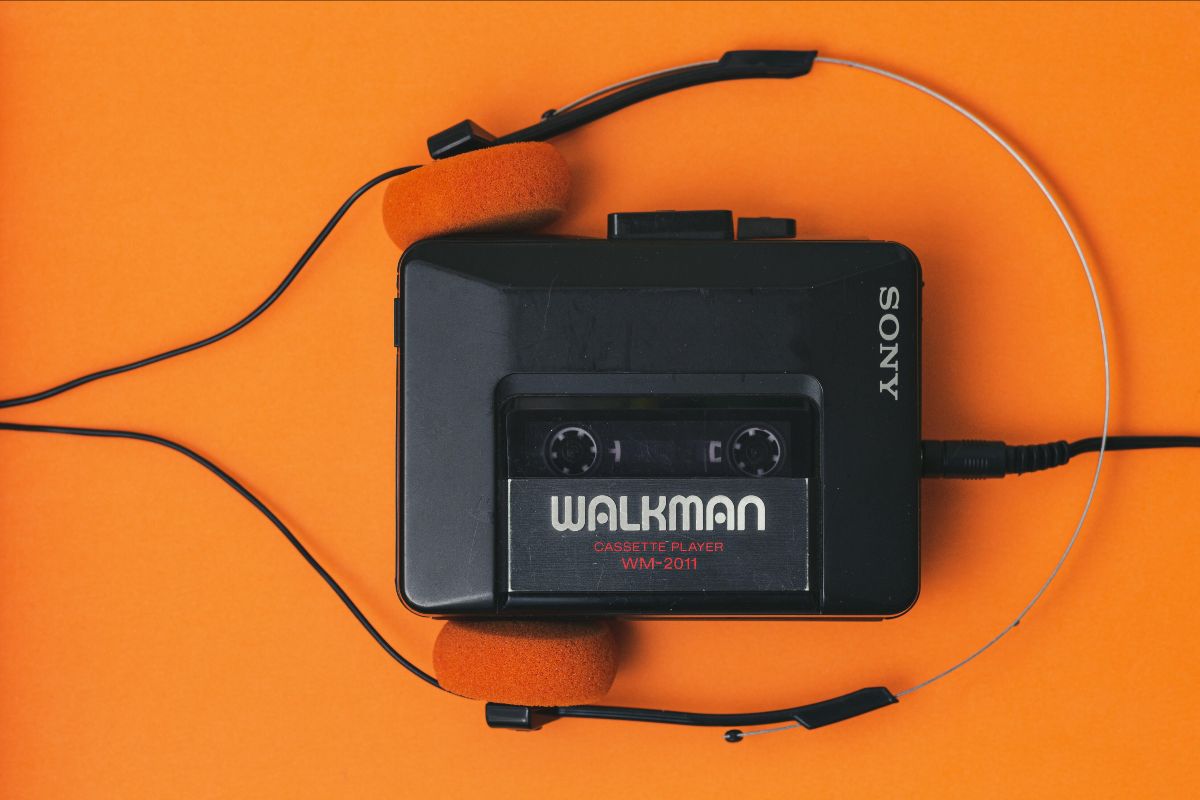
Now imagine him jogging back in the mid 1990’s listening to a book on cassette tape which was checked out from the library. He put the tape in a clunky Sony walkman, put his fuzzy headphones on and started to run. Now, picture him trying to flip the tape over after 30 minutes of listening to hear the rest of it…while still in motion. Not ideal…and he thought…”there has to be a better way.”
This led him to do some research and find that 93 million Americans drove to work alone every morning. He then extrapolated hundreds of hours of time that people sat in traffic, matched that number with the sociological data that showed the most frustrating and least valuable time of people’s day was…sitting in traffic.
He thought, why don’t I create a device that would allow people to listen to the digital content they wanted, whenever they wanted.
Running the numbers, he realized if he could just penetrate 9% of the people sitting in traffic alone every morning at $10/month for a service that would enrich their lives…how big could this business be? Let’s do the math:
9% of 93 million = 8.37 million
x $10 per person/month
= $83.7 million dollars per month in subscription fees.
So at age 43, with a supportive wife and 3 kids, he decided to ditch his career as an accomplished author and a journalist (for Rolling Stone) and take a 85% pay cut to start his new adventure.
It took Don another 10 plus years of barely surviving the dot-com bust until his luck finally changed with the release of the iPod and the timely partnership with Apple. Then in 2008, Amazon purchased Audible for $300 million. Ummmm….did you hear what I just said? $300 million?
Everyone has a great idea…and that idea and inspiration to start a new business can last a few days, a few weeks, or sometimes even a few years. When asked what motivated him to leave the comforts of a financial safety net and persevere for another 10 years until he finally saw the fruits, he responded with these 3 points:
- His loving father’s sudden passing at an early age marked his life in so many ways…and he sees a lot of patterns of fatherlessness in highly entrepreneurial people…whether from abandonment or early death which sometimes includes taking ridiculous risks.
- He thought it was so interesting that he would daydream more about this idea of digital audio content and player rather than daydreaming about the next paragraph that he was going to write.
- He kept talking and trying to get advice from people that he respected and they all thought he was crazy. This motivated him even more.
What I personally love most about this story is that even after selling the company to Amazon for…$300 million dollars, he continues his duties as a CEO and just recently in 2020 assumed the position of Founder and Executive Chairman of Audible. To me that says a lot about what this work means to him – that it’s less about getting paid, and more about seeing the original idea that everyone said couldn’t happen becoming reality. It’s a different way to think about our work – instead of just making money, we can be making our masterpiece.
I hope that inspires you as we go into this year – maybe 2022 can be the beginning of your origin story as well! It all starts with an idea…
Pick Up Line
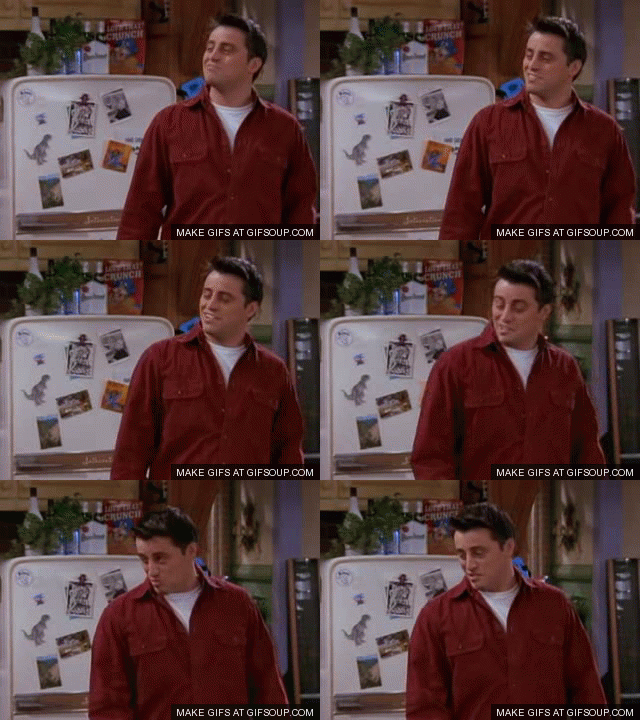
“So… how you doin?”
If you watched the show Friends, you heard this line from Joey many times, and you saw how unsuccessful it was with the target audience.
But what if your company’s marketing is having the same effect?
As a business, we are often too worried about our own self-image, our own self-interest, and our own capabilities that we forget about what our clients really need.
The key question is you need to ask is, how ARE they doing?
Instead of looking at yourself, become a student of your client. Find out their wants, their needs, their hopes, their fears. Take the focus off you, and figure out how you can create solutions for them.
The irony of great marketing is: It’s not about you. When you do it right, you’re not trying to make yourself look good. You’re just the guide to help others achieve their goals and dreams.
It reminds me of the story that Gay Zenola MacLaren shared in her memoir, about a chance encounter with Mark Twain:
He opened the door for me himself. As we said good-bye, he put his fingers lightly under my chin and lifted my head up so that my eyes met his.
“Little girl,” he said earnestly, “keep away from people who try to belittle your ambitions. Small people always do that, but the really great make you feel that you, too, can become great.”
At BOS Media Group, we believe that’s how digital marketing should work – it’s about making others feel that they can achieve greatness.
Maybe it’s time to re-think marketing. Know your audience, position your company to serve those needs, and make them the hero.
Please let us know if there’s anything we can do to help you shine!
What Problem Are You Solving?

In my last blog, I challenged you to come up with your worst idea. Hopefully, that opened up your mind to some new creative possibilities, but as you may have noticed: bad ideas don’t just automatically become a business (with the exception of the Shakeweight, of course).
The biggest question you need to ask if you want to turn your creativity into business is:
What problem are you solving?
It sounds simple, but most people don’t know how to answer this. You might have a product or service that starts doing well, but if you don’t know why, you won’t know how to build on the success.
You should be able to state this in a few words, or as Donald Miller calls it, “a one-liner” – a sentence that connects a pain point that people experience, and how your idea could resolve it.
Take a second to think about it: Where do you see someone having a problem? How could you address it?
Whether it’s a small idea to implement in your current business or a big idea for a new business, look around – the next great innovation might be right in front of you.
And that’s where flossing comes in.
NO, this isn’t about how people want to work with BOS Media Group because of my clean teeth (although obviously, it doesn’t hurt).
This is about a principle I once heard about how to develop healthy dental hygiene: if you’re currently not in the habit of flossing regularly, start by just committing to flossing ONE TOOTH.
It sounds weird, but you might be surprised – by lowering the commitment level, it removes barriers in your mind and increases your chance of success. One tooth is so easy, we don’t mind doing another, and before you know the small changes are big.
Which brings us back to your business. Start small. Look for a problem to solve. And please, let me know if there’s anything I can do to help you turn it into a business.
Worst Idea Ever

For many Americans, July is a time to appreciate our Founding Fathers and their world-changing creativity.
Obviously, I’m talking about watching Hamilton on Disney+.
This might sound weird, but the thing that stuck out the most to me is what a BAD IDEA it is. Translating a history book to Broadway through hip-hop should not work, and yet, here we are, living in Lin Manuel Miranda’s world.
I’ve had a similar thought about Pixar movies – I seriously wonder if some of their concepts were born from “What’s the absolute WORST IDEA we can think of?” (A rat in the kitchen? Trying to understand a teenager’s emotions? An elderly couple who can’t have children where one spouse dies without accomplishing their dream?) It’s like the more they corner themselves with a difficult concept, the more they’re forced to rise to meet the creative challenge – “Necessity is the mother of invention.”
This is especially important to think about at this time in history. As we continue to navigate a global pandemic and its economic impact, one thing is certain: business has changed, and it may never be the same again. How do we pivot and implement new ideas to take our business forward?
You may feel overwhelmed, but look around: what opportunities do you see? It could be in the way you’ve shifted your operation in the past few months, or in the adjustments required to work from home. Even on a personal level, pay attention to the innovative ways that you’ve managed home life, fitness, and nutrition, or online engagement – what do you see evolving around you?
At BOS Media, we believe that creativity is an infinite resource, where even the worst idea can end up opening new worlds. Our hope is that this ends up being a transformative time, as you dream big and experiment with imaginative ways to solve problems. We’d love to join you in that pursuit – please let us know if there’s anything we can do to help as you begin thinking and strategizing, and eventually as you take action to make it a reality.
In the meantime, the big question is: WHAT’S YOUR WORST IDEA? Honestly, we’d love to hear it – it really could be the gateway to your most creative work.
2020 Vision

Someone complained the other day about seeing way too many puns out there about having the perfect vision for the year 2020. So, you know what we say to that? We say, “here’s to the perfect vision for the year 2020!”. We know everyone goes into January with big dreams of making this the best year ever…and we do too! That’s a good thing. Don’t be cynical – let’s get our hopes up again, this is our year!
We are going to share 3 words for 2020 that can help you have the best year ever. Let’s unpack it together and get ready to be inspired, energized and excited for this year to unfold. It’s up to you. So, let’s make it matter.
Here’s our latest podcast episode #5
Are you a frequent podcast listener?
If you are, you can find us at the links below, please make sure to subscribe and share. We would also love to hear from you, so, just leave us a comment on the iTunes review or contact us here directly. In the meantime, thank you so much for being here and remember to always MAKE IT MATTER.
Go Big or Go Home

It’s 3 am. I’ve been thinking about this workshop for over a month now and I am about 3/4 way through preparing to teach it. I know it’s a subject that WILL help the small business owner, entrepreneur and dreamer alike, and I’ve had a feeling it was going to be a big hit. And it was, because it sold out in less than a week after just one registration post on my Facebook page. Well…sold out meaning, sign ups were full.I made $0 dollars. LOL. It’s a free workshop.
What sets you apart from anyone else? What makes you unique? Who are you? What is your promise? How are you achieving it? I ask these questions to clients that we work with in developing their brand. According the Seth Godin’s blog on “Small is the new Big“, all these questions can be summed up in one simple question; “what is your BIG?” For public companies, their BIG is the growth. For example, their BIG might be 10% growth year after year to infinity. This keeps the shareholders happy, keeps the doors open, the economy pumping and everyone making a profit. Their market to the masses and their ability to create products and services are at the highest performance rate with efficiency…that’s what they do. For us, we can’t even begin to compete with that. But we CAN offer something big companies won’t do that will add even more value. Our small is our BIG.
Okay, back to “It’s 3 am.” It’s a lot of pressure trying to prepare for a group of intelligent, talented and creative people from all different backgrounds…people with new incredible business ideas, people switching to a new industry, people with current successful businesses just wanting to do it better, people starting and running non-profits from an idea that birthed from their own pain and passion. I feel the pressure from my own doubts. “What could they possibly learn from me?” “How am I going to present this information so that it’s engaging and easy to follow?” “Is this even going to help them in their own entrepreneurial journey?” “Why am I offering this for free?” “How will this help me and my business?” I’ve poured a lot of time and energy into this workshop and according to my ROI calculation, a CFO from a public company would advise me to stop.
But I don’t. Because it’s 3 am, and I feel more energized than ever. I feel that I am in my element being useful, resourceful, relevant, and intentional. I feel this information I am about to share can motivate and help others to do well. And in helping others do well and helping others reach their dream, won’t it help me to fulfill mine? Yes! It will!.
This is my BIG. It won’t make sense in a P&L report, but it’s my BIG in the relationships I make and the lightbulbs that I help turn on and the inspiration and encouragement that I offer. So, what is your BIG? What is the unique piece of your business and culture you can call your own? What value can you continue to offer in exchange for your trust and your authenticity?
It’s 3 am, and I am more awake than ever! Let’s go BIG or go home.